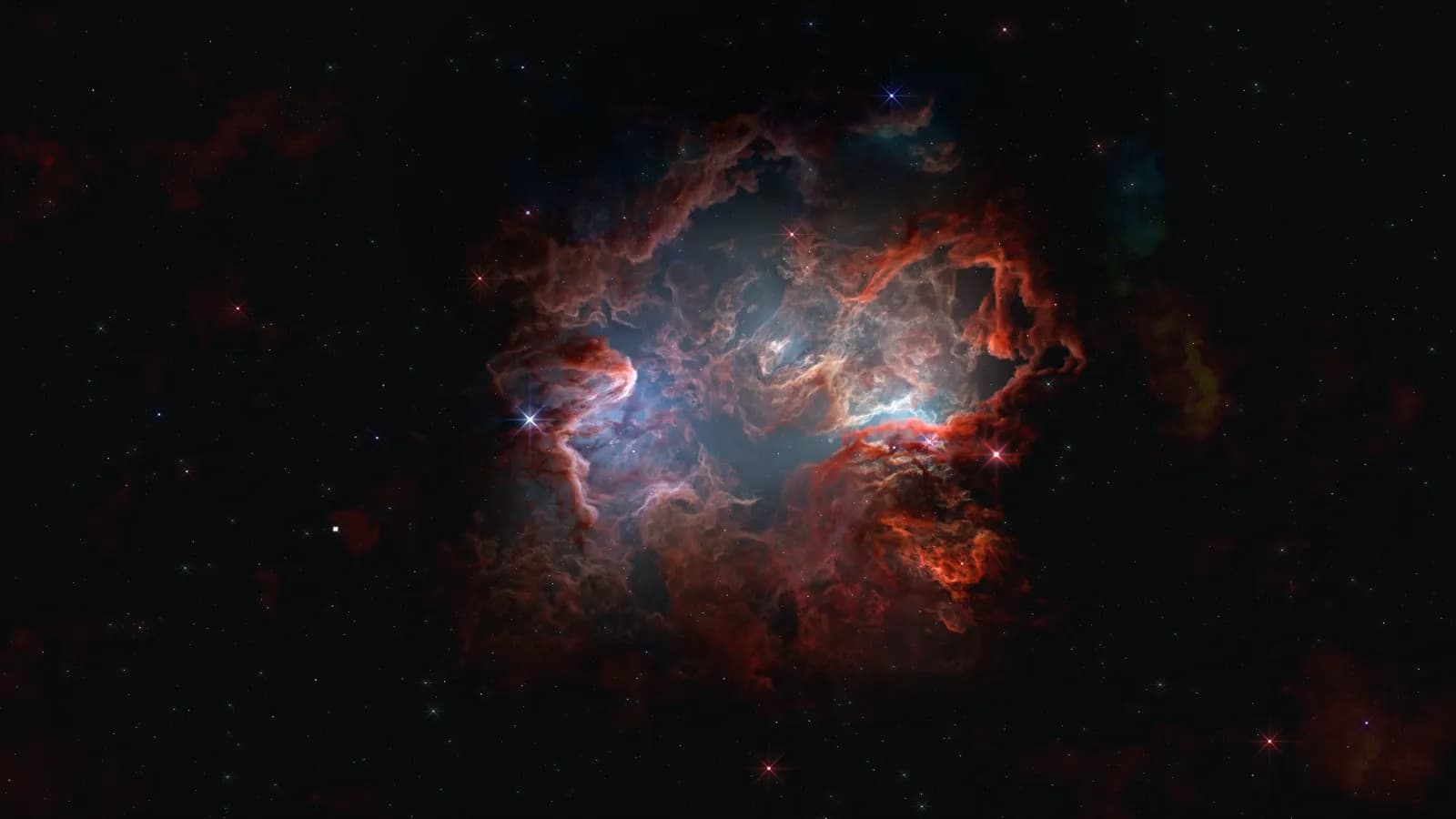
Scientists have achieved a miniature version of the Big Bang, creating the extreme state of matter that filled the universe moments after its birth. The breakthrough, reported by Wired on August 30, 2026, redefines the scale at which such conditions can be produced, showing that atoms need not be as large as previously thought.
The experiment produced a state of matter known as quark-gluon plasma, the hottest and densest form of matter, which existed in the early universe. Until now, researchers believed that only collisions of large atomic nuclei could generate this state. The new findings challenge that assumption, suggesting that smaller atoms can also trigger the transition.
A Smaller Threshold for Extreme Matter
The discovery hinges on the size of the atoms used in the collision. According to the Wired report, the results redefine how large atoms need to be to produce the extreme state of matter found in the early universe. This implies that the threshold for creating quark-gluon plasma is lower than previously established.
While the exact details of the experiment are not provided in the source, the implications are clear: the conditions of the early universe can be replicated with smaller systems than once believed. This could allow more laboratories to study this state of matter, as they may not require the largest particle accelerators.
Implications for Cosmology and Physics
The ability to create the littlest Big Bang opens new possibilities for studying the fundamental forces and particles that governed the universe's first moments. By using smaller atoms, scientists can probe the properties of quark-gluon plasma with greater precision and at different energy scales.
The redefinition of the required atom size also suggests that the early universe's conditions might have been more common than previously thought, potentially influencing models of cosmic evolution. Researchers will likely explore how these findings affect our understanding of the strong force and the behavior of matter at extreme densities.
The next step is to determine how small atoms can be while still producing this state, and what that means for the physics of the early universe. The Wired report does not specify when further results are expected, but the discovery sets the stage for a new wave of experiments.