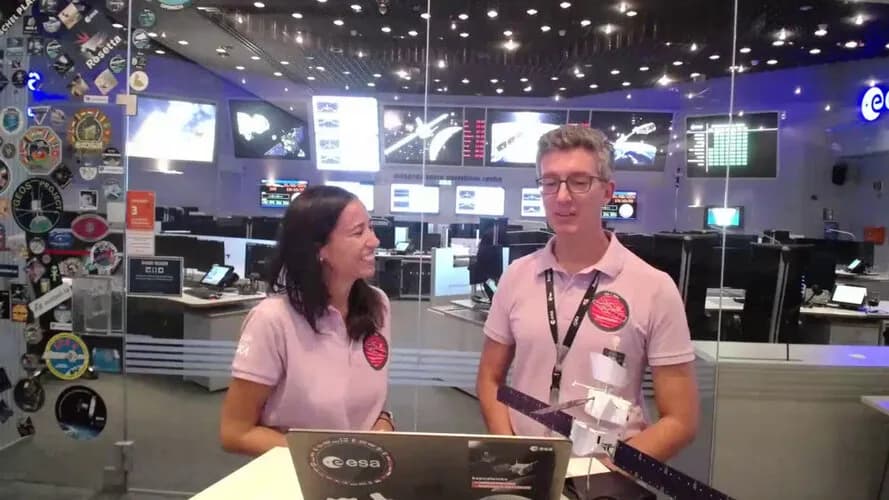
The European Space Agency held an online press briefing on 31 August 2026 to discuss the next critical step for the BepiColombo mission, a joint endeavor with JAXA and the first European and Japanese mission to Mercury. The briefing centered on the upcoming separation of the Mercury Transfer Module (MTM), scheduled for 3 September 2026. This separation is a key milestone that marks the beginning of BepiColombo's Mercury arrival phase.
The briefing, which lasted about one hour and ten minutes, also outlined the operational challenges and milestones that lie ahead. Among these are the Mercury orbit insertion planned for November 2026 and the subsequent separation of the two science orbiters, including ESA's Mercury Planetary Orbiter (MPO). The event was recorded and made available for rewatch.
A critical separation on 3 September
The separation of the Mercury Transfer Module is a delicate operation that must succeed for the mission to proceed. Once separated, the spacecraft stack will continue its journey toward Mercury, with the science orbiters preparing for their final configuration. The MTM has been responsible for propulsion and power during the long cruise phase, and its removal is essential for the orbiters to operate independently.
Operational challenges ahead
The briefing highlighted the complexities of the arrival phase, which includes precise maneuvers to enter orbit around Mercury in November 2026. After orbit insertion, the two science orbiters—ESA's MPO and JAXA's Mio (Mercury Magnetospheric Orbiter)—will separate to conduct their respective investigations. The mission aims to study Mercury's composition, magnetic field, and exosphere, providing insights into the planet's formation and evolution.
What happens next
The immediate focus is on the 3 September separation, which will be a critical test of the spacecraft's systems. Following that, the mission team will prepare for the November orbit insertion, a maneuver that will place BepiColombo into a polar orbit around Mercury. The success of these steps will determine the start of the science phase, which is expected to yield groundbreaking data from the innermost planet.